
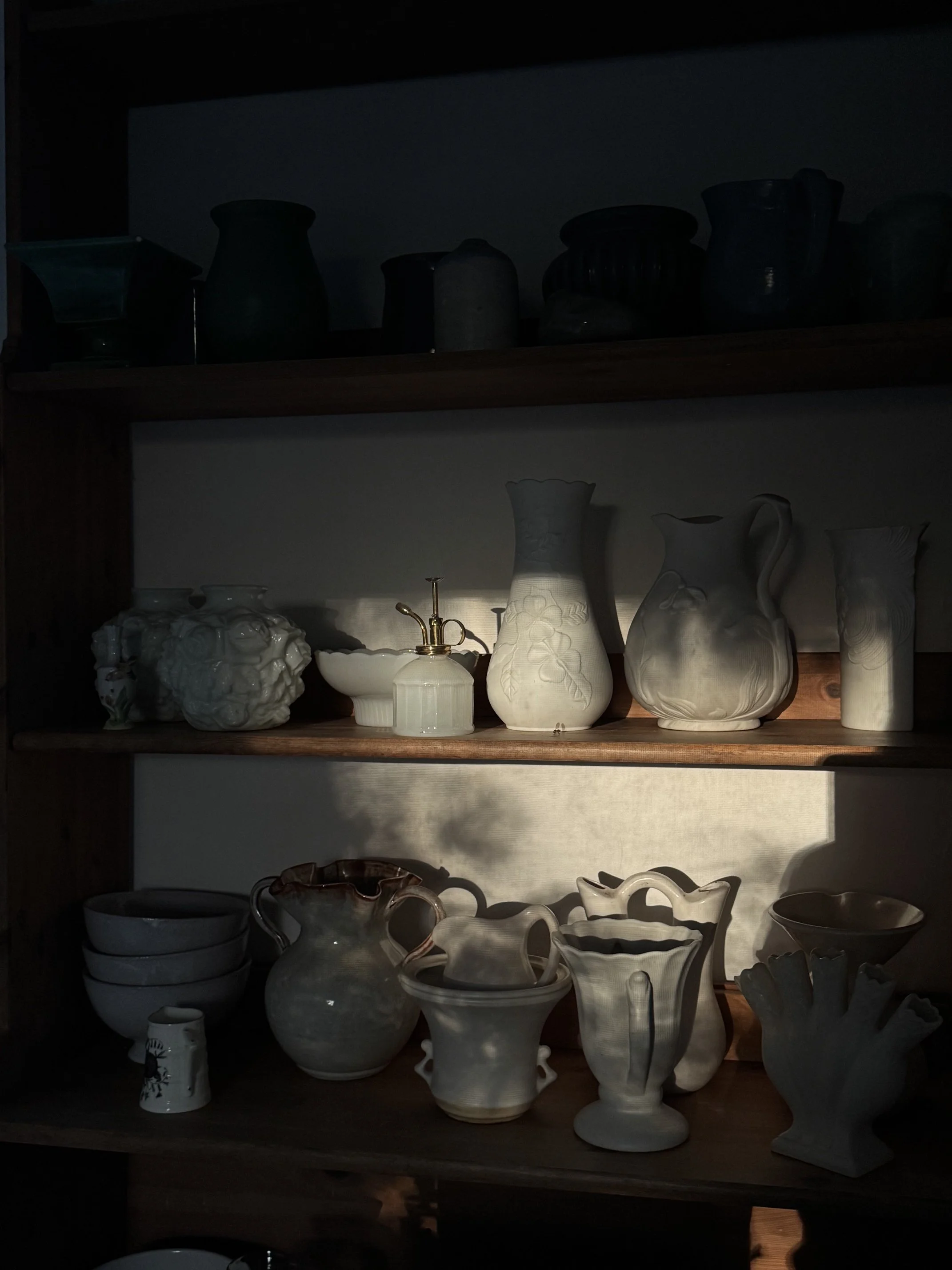
When you want your flower arrangements to live in a vessel that offers a clean pop for colors to bounce off of, white porcelain and glass is the way to go. It’s a material I’m always looking for when I’m thrifting or antiquing, not only for that reason, but because it’s a collection that looks just as gorgeous sitting on a shelf.
If you’re just beginning your own collection, here are 3 types of white vessels to help you narrow down your hunt and will add instant character and charm to your flowers and home:
1. Bisque Porcelain
Bisque porcelain has a soft, unglazed finish that almost resembles carved stone. Unlike glossy ceramics, it absorbs light rather than reflecting it, giving even the simplest vessel a beautiful, sculptural quality.
I'm especially drawn to pieces with botanical details, interesting silhouettes, and delicate relief patterns.
The only downside to bisque is that, due to its unglazed nature, it’s easy to scratch and stain so should be handled with care.
2. Milk Glass
The opaque, milky-white appearance of milk glass works beautifully alongside porcelain and stoneware, and it comes in an almost endless variety of shapes and patterns.
From hobnail vases to simple footed bowls, milk glass can feel either wonderfully old-fashioned or surprisingly modern, depending on what you pair it with.
I particularly love smaller milk glass vessels to create vignettes or little arrangements or long tablescapes.
3. White China
There's something timeless about white china, particularly old pitchers, creamers, and vases with delicate embossed details.
I look for interesting handles, scalloped edges, and subtle floral patterns that give a piece character without making it feel overly ornate.
Unlike bisque it is typically glazed and doesn’t scratch easily, but as you know it can be fragile. If you find your end up chipping one, no worries though - you can embrace the Japanese art of Kintsugi, in which pottery if repaired with gold dusted lacquer because the philosophy is to celebrate its imperfections as a beautiful part of the history and story of the piece. Admittedly you may not have gold dust on hand, but gluing a piece back on and seeing its crack as part of the new charm is still a way to embrace the outlook I think.